Cadence — Silent 4-head percussive massager
Cadence — Silent 4-head percussive massager
Limited stock!
Couldn't load pickup availability
- Paypal payment method
- Americanexpress payment method
- Mastercard payment method
- Visa payment method
- Applepay payment method
- Googlepay payment method
- Bancontact payment method

Cadence — Silent 4-head percussive massager
The problem isn't the vibration. It's the noise.
Everyone who has tried a massage gun on their horse knows the scene: you approach with the device, turn it on, and the horse backs away a meter. Not because of the sensation—it didn't even feel it yet. Because of the noise.
A horse's hearing is much keener than ours. A motor screaming at seventy decibels thirty centimeters from its neck sounds like a buzzing predator. No massage starts well under those conditions.
Cadence operates at 45 decibels. That is the level of a whispered conversation or a refrigerator in a kitchen. Quiet enough for a horse to keep eating its hay while you work on its back.
This is the first criterion we looked at, even before power.
Four heads, a larger surface area
Most massagers work with a single head over a few square centimeters. On a human calf, that is enough. On a horse's longissimus muscle, you would have to spend fifteen minutes there.
Cadence presses on four points simultaneously, arranged in a diamond shape. The surface covered is four times larger, the pressure is better distributed, and the session is significantly faster. On a neck or a croup, it changes everything.
Five speeds, from the gentlest setting—for introduction, for sensitive areas, for an older horse—up to a steady rhythm for large muscle masses after intense effort.

How to introduce it to your horse
This is where everything happens. A horse that discovers Cadence under the right conditions will accept it forever. A horse startled the first time will never want to see it again.
1. Device off. Present it, let the horse sniff it, simply rest it on the shoulder. Thirty seconds.
2. Speed 1, on the shoulder. A large muscle mass, not very sensitive, far from the head. This is the learning zone. Wait for the horse to lower its neck or start chewing—that is the sign it has understood.
3. Work your way up gradually. Neck, then wither, then back. Increase the speed only if the horse remains relaxed.
4. The jaw last, and only later. Not on the first day. Speed 1 or 2, for a few seconds, while watching the ears.
Where to use it
| Area | Recommended speed | Goal |
|---|---|---|
| Shoulder | 2 to 3 | Learning zone, and a real tension point for horses that pull |
| Neck | 2 to 3 | Along the neck, never on the topline |
| Back | 2 to 4 | The muscles on either side of the spine—never on the spine itself |
| Croup and hindquarters | 3 to 5 | The largest muscle mass, the one that absorbs the work |
| Jaw and poll | 1 to 2 | Tension related to the bit and bridle. Last, briefly |
What Cadence is not
It is not a medical device. It is a massager for comfort and recovery. It does not treat established contractures, lesions, or lameness.
It does not replace your osteopath or your veterinarian. It extends their work between sessions—many practitioners actually recommend maintenance work at home.
And there are places where it should not go: never directly on the spine, on a joint, on a tendon, on a protruding bony area, on a wound, or on an area that is hot, swollen, or painful to the touch. For a pregnant mare, ask your veterinarian for advice. When in doubt, do not insist.
The auto-shutoff, and why it's a good thing
Cadence shuts off on its own after 15 minutes. This isn't a technical limitation; it’s a safeguard: fifteen minutes is more than enough for a session, and massaging the same area for too long is counterproductive. If you want to continue on another area, turn it back on—the action simply forces you to change locations.
Cadence or Halo?
Both support recovery, but they don't do the same work.
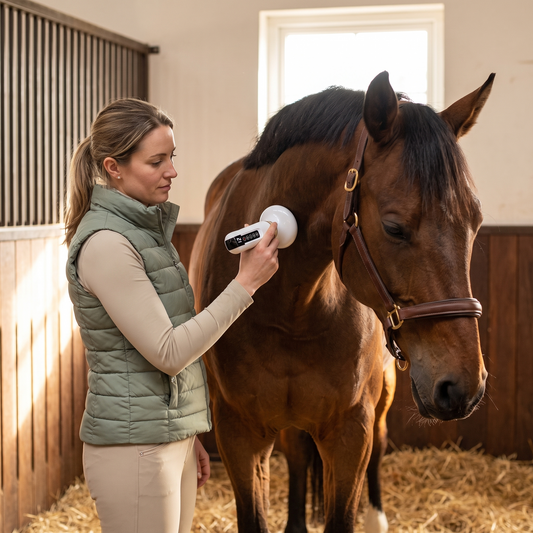
Halo suctions and illuminates: adjustable suction cup and red light, on a precise area, for deep and slow work. It is the tool for targeted care.
Cadence percusses: four heads, five speeds, on large muscle masses, quickly. It is the tool for the post-session routine.
Many riders use Cadence on the back and croup after work, and Halo on a specific identified tension point. They complement each other; neither replaces the other.
Specifications
| Massage heads | 4, fixed, arranged in a diamond |
| Speeds | 5 |
| Noise level | 45 dB |
| Motor | Brushless, 35 W |
| Battery | 2900 mAh rechargeable, integrated |
| Battery life | 3 h in actual use |
| Auto-shutoff | 15 minutes |
| Dimensions | 15 × 15 × 12 cm |
| Weight | 730 g |
| Materials | ABS and TPR — free of hazardous chemicals |
| Color | Black |
| Compliance | CE |
In the box
- The Cadence massager
- Charging cable
- User manual
Our commitments
- Free shipping on orders over €100
- 30 days to change your mind
- Quality customer service, reachable by email. Response within 48h


Frequently Asked Questions
My horse is afraid of devices. Will it work?
My horse is afraid of devices. Will it work?
How long per session?
How long per session?
How often?
How often?
Can I use it on myself?
Can I use it on myself?
Does this replace my osteopath?
Does this replace my osteopath?
Where should it absolutely not be used?
Where should it absolutely not be used?
3 hours of battery life, how many sessions does that cover?
3 hours of battery life, how many sessions does that cover?
RECOMMENDED PRODUCTS
-
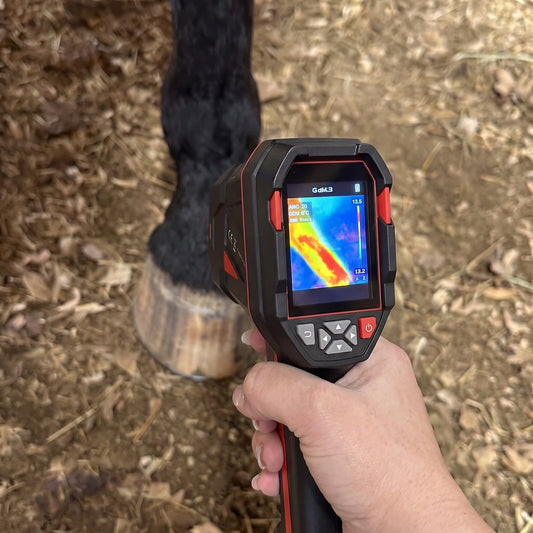
Vigie — Equestrian thermal camera | Automatic hot spot detection
Regular price €299,99Regular price €299,99 Sale priceUnit price per€399,9925% -

 SAVE 45%
Halo — Red light therapy suction cup
Regular price €109,99Regular price €109,99 Sale priceUnit price per€199,9945% -
Cadence — Silent 4-head percussive massager
Regular price €54,99Regular price €54,99 Sale priceUnit price per€109,9950% -

 SAVE 25%
Comfort Seat — Padded saddle cushion
Regular price €59,99Regular price €59,99 Sale priceUnit price per€79,9925%