Vigie — Equestrian thermal camera | Automatic hot spot detection
Vigie — Equestrian thermal camera | Automatic hot spot detection
Couldn't load pickup availability
- Paypal payment method
- American express payment method
- Master payment method
- Visa payment method
- Apple pay payment method
- Google pay payment method
- Bancontact payment method
Vigie — Equestrian thermal camera | Automatic hot spot detection

Description
Description
The hand is a good tool. It just runs a little behind.
Every rider knows the gesture: you run your hand down the limb, feeling for heat, comparing it to the other side. It’s a sound reflex, and it works—but only once the discrepancy is already obvious.
The problem is the threshold. The human skin struggles to distinguish a difference of less than two degrees, especially in cold weather, through winter hair, and with hands fresh out of a water bucket.
Vigie is sensitive down to 0.04 °C. It doesn't replace your hand: it gives it a scale.
The device finds the hot spot for you
That is what makes Vigie usable by someone who has never done thermography.
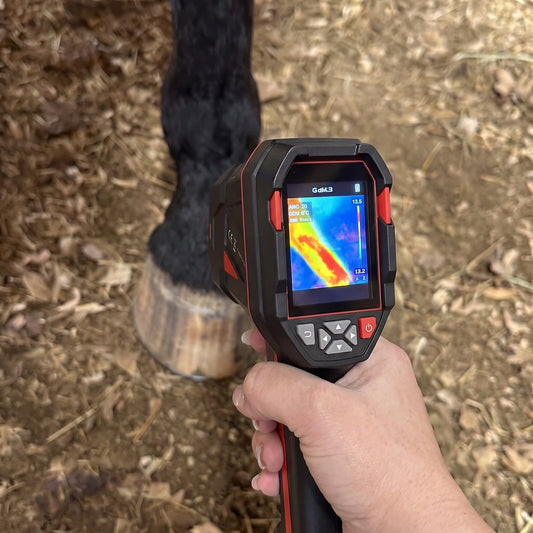
You aim at an area. The device analyzes the entire image and automatically marks the hottest point, with its temperature displayed on the screen. You do the same on the other side. You have two numbers to compare.
No interpreting color shades, no settings to figure out. Two measurements, one difference. That is all serious monitoring requires.

What you really use it to look at
Symmetry, above all
This is the basic principle of equine thermography, and the simplest: you don't read a temperature, you compare two sides. Left forelimb against right forelimb. Left back muscle against the right one. A healthy horse is generally symmetrical. A marked difference between two equivalent areas is a signal that there is something to look at more closely—not a diagnosis, but an indication.
Saddle fit
This is the use riders keep for the longest time. After work, you remove the saddle and look at the back: areas of friction and compression appear clearly. A saddle that presses on one side is immediately visible—and above all, you can compare before and after a saddle fitter's adjustment instead of relying on a feeling.
Tracking over time
A single image doesn't say much. Two images of the same back three weeks apart, taken under the same conditions, say a lot.
The images are saved as JPGs on the provided 8 GB memory card and transferred to a computer via the USB-C cable. You build a dated history that your veterinarian or osteopath can actually put to use.
After the farrier
A change in conformation, a shift in weight-bearing: this translates into temperature differences between the four hooves. A check two days after shoeing, and you know if something has shifted.
Distance is half the work
This is the point no one will tell you on other product sheets, yet it is what separates a usable image from one that means nothing.
A thermal camera has finite resolution. The further away you move, the larger the surface area each point of the image covers on the horse, and the more the discrepancies get lost in the average.
| Distance | Ground resolution | Use for |
|---|---|---|
| 0.5 m | ~5 mm per point | A limb, a tendon, a hoof, a precise area |
| 1 m | ~1 cm per point | Half a back, a shoulder, a muscle mass |
| 2 m and beyond | 2 cm and more | Nothing usable on a horse |
Therefore, we work by areas, never on the whole horse. Five shots at one meter are infinitely better than a single overall view at three meters. Furthermore, the device includes distance compensation at 0.5 / 1 / 2 / 3 m: set it to the actual distance, and keep the same one from one session to the next.
This protocol is detailed in the provided guide.
How to use it
1. Always under the same conditions. Horse dry, at rest for at least twenty minutes, sheltered from wind and direct sunlight. Not right after a shower or right out of the trailer.
2. At the right distance. 0.5 m for a limb, 1 m for the back. Perpendicular to the area, same angle from one time to the next.
3. Always both sides. Left then right, in quick succession. It is the difference that speaks, never the absolute value.
4. Date and keep. A series over time is worth a hundred isolated images.
What Vigie is not
It is not a diagnostic device. Vigie measures surface temperatures, nothing more. It does not detect inflammation, predict lameness, or say what a horse has. A thermal image only makes sense when interpreted in context: the previous day's exercise, the weather, or a blanket removed ten minutes earlier are enough to change what you see.
What Vigie does well is give you an objective reason to call your vet sooner—or not to call them. That is already a lot.
The accompanying guide
A thermal camera without a protocol is a camera without knowing how to frame a shot.
Each Vigie comes with our equine thermography guide: the complete shooting protocol, the five areas to photograph in order with their diagrams, three commented examples of symmetry reading, classic pitfalls (sun, wind, blankets, mud, winter hair), a tracking sheet to print, and benchmarks for knowing when to call your vet.
This guide is what makes the difference between a device that stays in its case and one you use every two weeks.
Specifications
| Sensor | Long-wave infrared 8 – 14 µm |
| Thermal resolution | 96 × 96 points |
| Thermal sensitivity (NETD) | 0.04 °C |
| Measurement accuracy | ± 2 °C or ± 2% of reading |
| Field of view | 50° × 37.2° |
| Distance compensation | 0.5 / 1 / 2 / 3 m |
| Measurement | Hottest, coldest, and center point, automatic |
| Frame rate | 25 Hz |
| Measurement range | -20 °C to +150 °C, and +150 °C to +550 °C |
| Palettes | White Hot, Black Hot, High Contrast, Iron Red |
| Infrared rendering | Soft, sharpened, high contrast |
| Screen | 2.8-inch touchscreen |
| Storage | 8 GB memory card included — JPG format images |
| Connection | USB-C — charging and file transfer |
| Battery | Lithium 2000 mAh — approx. 6 hours of battery life |
| Dimensions | 70 × 80 × 200 mm |
| Weight | 260 g |
| Operating temperature | -10 °C to +60 °C |
| Compliance | CE, FCC, RoHS |
| Manufacturer warranty | 2 years |
In the box
- Vigie thermal camera
- Battery, pre-installed
- 8 GB memory card
- USB-C cable
- Hippalya equine thermography guide
Our commitments
- Free shipping in mainland France
- 30 days to change your mind — full refund, no justification needed
- 2-year manufacturer warranty
- Quality customer service, reachable by email. Response within 48h


Frequently Asked Questions
Is training required to use it?
Is training required to use it?
Does this replace the veterinarian?
Does this replace the veterinarian?
How far away should I stand?
How far away should I stand?
Does the winter coat interfere with the measurement?
Does the winter coat interfere with the measurement?
Can I use it right after work?
Can I use it right after work?
Can I retrieve the images on my computer?
Can I retrieve the images on my computer?
Can I use it for something else?
Can I use it for something else?
RECOMMENDED PRODUCTS
-
Vigie — Equestrian thermal camera | Automatic hot spot detection
Regular price €299,99Regular price €299,99 Sale priceUnit price per€399,9925% -

 SAVE 45%
Halo — Red light therapy suction cup
Regular price €109,99Regular price €109,99 Sale priceUnit price per€199,9945% -
Cadence — Silent 4-head percussive massager
Regular price €54,99Regular price €54,99 Sale priceUnit price per€109,9950% -

 SAVE 25%
Comfort Seat — Padded saddle cushion
Regular price €59,99Regular price €59,99 Sale priceUnit price per€79,9925%